Monday, August 12, 2019

Sustaining a Career

Today is my birthday, and I took the day off from work. Naturally, I feel naked and confused without using a computer, so I started a birthday fundraiser on Facebook for the Cleveland Restoration Society, and then I had to jump online to write this post. Now with the salutations out of the way, I will jump forward to why I am writing to you.

Last week, someone posted on a historic preservation professionals group about what burns people out or any tips-or-tricks to staying motivated and engaged. My automatic response was, "focus on what I love--learning." Since posting my automatic reply, I have wondered why I led with that answer? I could have chosen to talk about what burns me out, but rather I focused on what gets me up and helps me stay focused when I sit at a computer researching and writing, sometimes more than 14 hours, every day. What I also started to think about something that I have wondered about in-depth for quite a while--how do you stay motived in a preservation career?

Sometimes when we start a career we are so focused on 'getting that job' that we lack perspective on how to keep, nurture, and grow ourselves. In no specific order, this is how I have shaped my career while also staying grounded over the last decade:

  • Think long term
    • Set goals for whatever job or volunteer opportunity you have both short and long term. You don't have to be the President of the National Trust for Historic Preservation to have value or participate in implementing preservation policy. In fact, you may actually be more impactful than such individuals. Give yourself at least five achievable goals each week and either mark them off or revise them for the next week.
  • Define you
    • Grow your own understanding of what you do want with your career and life. Journal or simply just think about it while sipping coffee. What do you like most about your days? What would you like to change? For example, I thought I wanted to be someone who worked in business development, but then I realized that I don't enjoy the required client face time that is necessary to succeed in that job. I really enjoy research and writing the most in solitude. This, of course, can change, but this is what makes me happy now.
  • Make allies
    • Networking is what they say, but so many people do it wrong. Don't approach someone who you think can give you something (i.e. their contacts, a job, etc.). Approaching someone with an intention to learn, engage, support, foster, help, or advocate is best. You can say, "I really learned a lot from that blog you posted," or, "I am interested to help  your volunteer group because I share your passion." There are so many people wanting important folks time that why would they give you something. The world doesn't owe you anything. Also, you are an important person, too. So, why come on a bended knee. Instead, focus on getting to know people--for real--and then step up when you are needed. An allied front is better than some quid-pro-quo exchange in the long term, and the long term is the game. 
  • Time and hard work is required
    • I've been on both sides of this argument; "Millennials expect to be the boss right out of college," or, "Since I have an advanced degree and work experience, I am qualified for leadership because I have the skills and character to do a great job." Look, let us look this in the eye, and face this straight on. If you are under 40, regardless of your qualifications, more saged professionals want you to ask them questions, and they want you to engage with their wisdom. Maybe you do have what it takes or the right answer, but you are going to have to come at it from a different angle. After all, they were already you in their careers. Again, think long term, define you, and make allies. 
  • You do you
    • Preservation is about improving consumption habits in humans that developed over centuries. That, one, passion project you, may have, had success on doesn't change the big picture. You also shouldn't be viewing your success against preservation globally. Ten years ago, I was a hot-headed, opinionated, utopianist. I had a now or never attitude, and if I continued with such fervor I would have burnt out. I backed up, went back to the drawing board, and focused on the most important part of the equation--my happiness. I am nowhere near where I thought I would be in  'a' career, but I am farther along in my career than I could have imagined a decade ago. 


Saturday, October 20, 2012

stew·ard

1stew·ard

noun \ˈstü-ərd, ˈstyü-; ˈst(y)rd\

Definition of STEWARD

1
: one employed in a large household or estate to manage domestic concerns (as the supervision of servants, collection of rents, and keeping of accounts)
3
: a fiscal agent
4
a : an employee on a ship, airplane, bus, or train who manages the provisioning of food and attends passengers
b : one appointed to supervise the provision and distribution of food and drink in an institution
5
: one who actively directs affairs : manager

Friday, October 19, 2012

Cleveland Museum of Natural History: Whats war got to do, got to do with it?

Architecture is reaction and prediction.

Preservation is about documenting and explaining the architecture; thus, what the designer and client was reacting to, and what the designer was predicting.

Recently in preservation, there is an increased interest in mid-20th century, whereas twenty years ago the rising interest was vernacular urban neighborhoods. Furthermore, fifty plus years ago the interest was recreating Colonial America, and one hundred plus years ago, it was about saving the original colonial history.

We could speak globally about preservation or conservation trends, but we are just going to stick with the US, and particularly, Cleveland, Ohio.

2012 Cleveland Museum of Natural History

Now, yesterday I was able to attend the Cleveland Museum of Natural History's Building with Nature Symposium. It was an eight hour lecture on sustainable, assumed to be sustainable, architecture. Why did the museum put on such a symposium you ask? Well, they are planning to build a new "statement" campus.

Great right? Construction in Cleveland means jobs and progress, right?

Well, not entirely so great for me, the preservationist.

As I sat in the audience, I looked around thinking, "Well, I guess all the literature I read about preservation being left out of the sustainability conservation is true," because there was no preservationist on the lecture panel. Not. A. One.

The audience was shocking thoughtful, many questioned the new green gizmo case studies with skepticism and hesitancy to adopt such a standard. Many questioned, why they weren't seeing indigenous materials?

My reaction to the presentations were--stop.

Stop and consider the building you have.

In sustainability, we talk about doing more with less.
Then doing more with less must include starting with what you have?

Yesterday and this morning, I took the task of researching popular opinion on the existing Cleveland Museum of Natural History, built between 1958-1961. Anyone over the age of forty-five winced their eyes and issues a death warrant for the building because of aesthetics. Anyone under forty-five had a less abrasive opinion on the building, they wanted to see it live. One of the unknowing test subjects, over the age of fifty, had no opinion, because the building didn't really every stand out in their memory.

The building, the architecture did what it meant to: react to a post-war, Cold War, nuclear period of time, where interior space was the purpose. The building, the brown brick veneer, blended into its environment so well, that many people didn't really notice it. The building, that houses a natural history collection, didn't obtrude between the interior happenings and the exterior world.

I don't know about you, but a building, built after nuclear fear for a natural history collection, probably shouldn't be the "statement".


2008 Fentress Architecture, Proposed Renovation & Expansion


Saturday, October 13, 2012

Dealth of Possiblity


When I came across a glossy flyer for the proposed demolition and expansion of "urban" garden space at the Dunham Tavern, I was taken a back. My favorite potential re-use project was Photoshopped, however poorly, out of the image. Yes, the recently demolished reinforced concrete modernist industrial building on Euclid was my favorite reuse prospect in the city of Cleveland.

As I shared my discontent with colleagues in City Planning and Landmarks, I received some perplexed expressions and some shaking heads of agreement. Why was this architecturally uninteresting building of interest to a historic preservationist?

In preservation we argue to save context, but somehow, if the context isn't pretty enough or backed by financial gurus, we easily dismiss the resources and issue its death warrant.

Today, I found a local blogger, Daniel DeAngelo, who shared my frustration.
http://thecivicartcleveland.blogspot.com/2012/06/proposed-dunham-green-good-or-bad-for.html

In his blog entry, DeAngelo shows examples of what the Dunham Tavern project is attempting to accomplish. But in his examples, he shows why the project is ultimately faulty.

The example of Philadelphia's Rittenhouse Square made me giggle. Cleveland's Midtown is NOT Philadelphia's Rittenhouse Square. Now, we are not haters, we are realistic. In DeAngelo's article he states, the Rittenhouse Square location has been desirable since the 1800s. This is simply not true of MidTown.

Trying to use urban gardening and demolition of buildings as a solution to disinvestment has short-lived benefits and long-term devastating effects. Simply look at MidTown and the Hough neighborhood to find examples of why demolition spurs further demolition. Some of the late Councilwoman Fannie Lewis' mcmansion solutions sit abandoned and boarded next to vacant lot after vacant lot with random old buildings isolated in a sea of vacant lots.

So, the building has since been cleared, the vacant lot remains. The Dunham Tavern now stands alone in an artificially created historic environment.

Cleveland, what are you? Where you not an industrial giant? Do you not want to rebuild with new industry?
If so, then stop demolishing the buildings that will be home to this revolution.

The embodied energy of the 6611 Euclid Avenue building was equivalent of 607304 gallons of gas.
While the demolition alone cost 864000000 worth of gallons of gas.

For a firsthand look at the demolition and celebration, see:
 http://www.newsnet5.com/dpp/news/local_news/cleveland_metro/euclid-avenue-building-in-cleveland-demolished-for-expansion-of-historic-dunham-tavern-museum

Tuesday, August 28, 2012

The Business of Heritage.

In June 2012, I participated in the National Trust for Historic Preservation's Preservation Leadership Training held in Beaufort, SC. Part of the experience included me growing up, growing aware and believing in myself as a preservation leader.

I received mixed responses when I told people about applying for the training. As with most of my experiences, I was told, "who do you think you are to be applying for such a 'high level' training, you are just beginning your career," to, "I wouldn't have thought you would apply for something like that, because you aren't really an affiliate of the Trust," to, "I am surprised that you would want to pay money for that," and my most favorite, "you're not a preservationist." Well, I was accepted by the Trust, I was able to pay my way, and the training has been complete for over a month now. I even have the paper certificate to prove my successful completion, but what did I really gain?

Aside from gaining self confidence and belief in myself as a professional, I gained experience working with strangers in an unfamiliar city, and I gained experience being creative with numbers. I gained knowledge of the unfamiliar city, culture and people. I became more determined to remain open-minded and objective. I began to believe in the ability of true teamwork.

I would like to thank the members of the Purple Team for being true beings with purpose and dedication. For some, the trip to Beaufort would have just been a vacation, but for us... it was a trial and tribulation.

Believe in yourself, and you will find yourself surrounded by others who feel likewise.

Material, Material, Who is the Fairest of Them All?

Harriet Estel Berman blogged about the topic of documentation with reference to artistic works. She states:

"Photographic documentation (including video and film) can be especially important when working with alternative or unproven materials. While the temporal nature of the materials may be a critical characteristic that makes the work interesting, the documentation may be the only aspect that survives for posterity.  A photo clearly establishes exactly how the artist visualized the work, fresh - before it ages, degrades, or disappears."

When it comes to conserving the built world, preservationists have been combating the cycle of deterioration with photographic documentation for over a century. The WPA era brought about the HABS/HAER project, and numerous other film ventures. The City Poem emerged as a moving story of depression era Americana.

But, preservationists continue to fight the urge to document alone, despite the relative success of such endeavors.

Public history has hammered into the preservation psyche for several decades. Social history and the American vernacular remains a prevalent piece to contemporary preservation, as mounting environmental concerns continue to nag professionals. For some, the "preserve at all cost" mentality is wrought with elitism and a classicist mentality, which includes the preservation and focus of social, public history. As Americans clamber to produce revisionist histories, the environmental concern is pushed onto the back burner.

Now, this post is not arguing that social history has no place in preservation, but it is arguing that preservation is a material based discipline.Shouldn't preservation be focusing on the conservation of material rather than narrative?

The photo document is strong evidence. In some cases, a picture is worth a thousand words, or a thousand vernacular structures that have been severely altered. If preservationist accept that some buildings are meant to meet the bulldozer, document accordingly, then perhaps efforts can begin to focus on more substantial issues, like carbon footprint and the lagging job market.

The author of this post has surveyed and written over 400 histories of buildings across Cleveland, Ohio. Sometimes, the picture is the best story. Sometimes, the building is just a building. The real cost to community is focusing on revisionist histories.

Time rights past wrongs, but only through education and progress of the individual.

Human beings, tribal animals, truly can never be appeased by one history.

We can learn from photo documentation, and it costs far less than attempting to stabilize a sinking neighborhood. We can archive, preserve and make certain that these images are protected. We can't guarantee the same to failing neighborhoods, and a historic designation doesn't always save the most threatened unless effort is unleashed in numerous ways.

Environmental consciousness allows preservationists to promote their cause, inspire others, and conserve object. Social history is still important, but sinking precious financial resources into such endeavors most often does little. Photo documentation is a tool to be used cautiously. One can document "progress". One can argue the preservation of vital resources, and the integration of new techniques to further sustainability communities.

Tuesday, May 29, 2012

Clyde Alexander Patterson

Today I had the opportunity to page through a box of paper collected by Clyde Alexander Patterson.

He taught at Kent State University in Architecture and Environmental Design.

He led numerous historic building surveys in Cleveland during the mid-late 1970s.

Now, a box of paper sits in the attic of City Hall, as well as, his personal briefcase.

I will be posting some of his publications on effort to promote work done before the advent of the internet that now can gain public access through digitization.

Wednesday, April 4, 2012

Sustainable Preservation

"Every year, another 1 million acres of farmland in the United States is given over to buildings," Carroon.

Sustainable Preservation by Jean Carroon is, mostly, viewable through Google books.

There is a clear explanation of how EXISTING buildings are inherently green.
It is important to explain what this means to those you speak to...
Often, I overhear preservation professionals throwing out these key phrases with little background information.
The general public doesn't have the facts, and offering a few sentences after making such claims is very helpful in convincing those who aren't in the know.

The concept of "long-life/loose-fit"  (as coined by Steve Brand in How Building Learn/ What Happens After they're Built) is noted in this volume, and it is really the zinger for the argument pro-sustainability. Historic Preservation has the adaptive reuse method, which demonstrates successful long-life/loose-fit examples.
Layering this concept with conventional preservation practices shows that we can respectfully add green technologies to historic buildings while keeping to our traditional standards. It just takes a little more thinking outside of the box to appropriate design a retrofit project that both enhances and respects the EXISTING building.

Additionally, the complex nature of construction costs have slashed the argument for new construction as more cost effective than greening retrofits. Carroon references two reports by Davis Langdon that "there are so many cost factors in construction today that it is nearly impossible to detect any statistically significant difference between the cost of conventional and green buildings."

The quote by Stewart Brand states that, "A building is not something you finish. A building is something you start." What the take home is from this book is that Sustainable Preservation is real, happening, and what we should be convincing the greater community to do.But first, outreach that inspires acculturation toward reuse is necessary.

SHOAH Institute

This winter I attended a digital humanities seminar at Case Western Reserve University.

One of the presentations included the SHOAH Foundation Institute started by Steven Spielberg.

While not free--- it is an interested project to reference.

There are interviews available for free on YouTube.

Thursday, March 1, 2012

Change is a historical theme.

I really fail to understand why in the American ideal of  historic preservation that change is considered the enemy.

Also, I am confused as to why in the American ideal of historic preservation that preservation is lumped into one concept. Whereas, the actual practice displays three treatments for managing historic resources: stabilization, rehabilitation and restoration.

If then, we can acknowledge that preservation is more than simply keeping a building some period of time, like a museum artifact rather than a living system, and that it has more than one means to its goal, then why can't some of its practicioners

Friday, February 10, 2012

Adapting Preservation Prospectus

Adapting Preservation Prospectus

The above link is to a final draft of my prospectus, Adapting Preservation: The Cleveland Environmental Center.

You are invited to attend my public prospectus hearing at Ursuline College on February 28, 2012 from 7-9pm.

Please contact me for room information via jwobig@ursuline.edu

An electronic version of the presentation will be made available after the formal hearing.

Wednesday, February 8, 2012

One of the more historically significant subdivisions in Glenville is the C.C. Baldwin Allotment. Baldwin, one of the founders of the Western Reserve Historical Society (formally, the Cleveland Library Association's Historical Department). His son is one of the founder's of Baldwin Wallace College and the Cleveland Museum of Natural History.

Last year, I spent my time surveying a portion of the Glenville neighborhood in Cleveland, Ohio.
It is a prominently residential area with one main node of commerce along E.105th Street. The neighborhood cascades along Rockefeller Park, as listed on the National Register of Historic Places.
Few standing resources predate the park, and most of the buildings are from the first decade of the 20th Century. Part of the problem of my survey from last year stemmed from there being little left from this significant time period. Before the invasion of early 20th Century Cleveland Doubles, there were homesteads, barns, and light industry here. Blacksmiths and adventurous business class families.

What will we remember from the 20th Century? Will there be anything left to show the history of African Americans, who have resided in Glenville, despite the street wars of the 1960s, the urban blight of today?


1237 E.100th Street, Cleveland, Ohio
Yesterday, myself and Don Petit of the Landmarks Commission, were driving around snapping historic candid shots for the upcoming meeting this Thursday. As several resources along Superior Avenue on E.99th and E.101st Street are on the docket for potential landmark designation, we ambled down some of the streets from last year's survey.

How quickly the built environment changes.

1237 E.100th Street, Cleveland, Ohio
As we turned from Tanner Avenue onto E.100th Street, the second lot on the easterly side of the street showed a gaping hole and a staircase to nowhere.

To the north-east, Glenville Village prospered, offered entertainment amenities, like League Park and a horse race track, and boasted residential and commercial assets.

Doan's Corners (formally Doan's Settlement, then East Cleveland, then annexed to Cleveland),  located at Euclid Avenue, E.105th (formally, Doan), and E. 107th Street being one of the earliest stops in the Western Reserve, named for the surveyor Nathaniel  Doan, who built an Inn on a portion of the land he gained for his survey work. Of course, his survey work is the 1797 survey led by Moses Cleaveland, the founder of Cleveland.

History relatively so recent that trace elements exist in original paper documents housed at the Western Reserve Historical Society Archive and Library. Yet, history far enough in the past to have little weight in our contemporary lives, or does it have more impact than we realize?

I will admit, it was difficult to stroll down E.100th Street to find another resource reduced to, as the demolition contractor said, "brown rubble". While I am not a born resident of the neighborhood or have any family ties to the area, I have gained a developmental history on the area that covers multiple generations from the inception of the Western Reserve.

It is hard to be unaffected by the removal of an artifact, that to some appears a nuisance, but to the historian and preservationist an opportunity.

It is frustrating to know that people's bad investments somehow become our loss.

Also, frustrating to know the social history of mid-20th Century, Urban Renewal, and the realization that it is happening--again.

Tuesday, February 7, 2012

Just a thought...

Major Jackson's Campaign Promises

Just a little interesting to consider what Mayor Frank Jackson listed on his re-election campaign.
One of the top public service priorities lists, "Continue record-setting pace of condemned structure demolition and increase programming to rehabilitate houses that should be saved."

Yet, there is no preservation plan to decide what constitutes what "should be saved". Mind you, it is now 2012 and the campaign is from 2009.

There are intriguing plans for creating green industries, but little green industries occurring. I think most of the unemployed residents surrounding greater Cleveland are still waiting for those ever promised green collar jobs.

The amusing part, well sickly humorous aspect, is that given that Jackson tooted the need for record-setting demolitions, funding for the preservation end of the city is rapidly decreasing and little power given to its already existing, Landmarks Commission.

It seems that the plan should read, a future for a homogenized and  new poorly constructed Cleveland.

How does a City foster green industries? Well, it certainly doesn't do this by the demolition of its already existing resources. Since, a rapid plan for demolition is not a sustainable action.

Sunday, February 5, 2012

Photography and Illustrations WANTED!

Do you have photography or illustrations that you might consider donating or licensing at an extremely small cost for my thesis?

I am looking for images that demonstrate the:

Global Digital Culture and Sustainability.

Images could be complex historical sites with overlay graphics of cables, wires or data.

Embodied images that show the need or demonstrate the sustainable approach.

Images of the Cleveland Environmental Center, Cleveland, Ohio.

Contact me via FaceBook or jwobig@ursuline.edu 

Thursday, January 12, 2012

Why not just level the entire city?

Here are some factoids for you---

For the first time in history the world is predominately urban.

Meaning, we all pretty much live cities!

Our urban centers became blighted post-1950s white flight to the suburbs.

These centers are now visible in the sights of investors and historic building and infrastructure is either being renovated or demolished.

Did you know that 78 percent of our land fills consist of building debris?

Did you know that my five-year-old knows the concept of recycling and practices it?

Voila! If a child understands that our resources deserve proper respect and treatment shouldn't our city leaders understand and practice the same for our built resources?

In an increasingly urban environment there are many pressures for redevelopment. How can we better educate our leadership and those who fund projects about preservation of our environment (both naturally occuring and man-made)?

Wednesday, January 11, 2012

What should preservation organizations do?

http://blog.preservationnation.org/2010/08/24/national-trust-mountainsplains-office-to-green-125-year-old-school/

Well, in Colorado the National Trust's Mountain/Plains Office is undertaking a $2.3million dollar rehab of a 125 year old school!

Note to the reader: the author believes that preservation organizations should be in the business of purchasing, rehabbing and actively programming their projects.

In the case of the Emerson, CO school... who else would have initiated such a progressive concept---rehabilitating a historic building for current use---besides a preservation group?

Monday, January 9, 2012

So what about historic districts?

http://www.theatlantic.com/national/archive/2011/09/clevelands-disappearing-warehouse-district-then-and-now/245080/

Check out the above link and then read this blog entry.

The visual reference shows the simultaneous failure and success of historic districts in Cleveland, Ohio.

Why does the use of historic districts struggle in Cleveland?

I suppose the better, and more constructive, question to ask would be, "how does it succeed?"

If we analyze the two images on the provided link again... we might see something a little more vibrant.

Obviously, a lot of buildings were lost, and their former sites became parking lots.

Okay, we've known this factor of living in mid-western USA, but what we can notice is the fact that this area is in use and active.

While many buildings were slain to accommodate the automobile's demands, this cluster of early 20th century buildings remain in use and attractive to both reuse and redevelopment of nearby land.

Cleveland may not remain as intact as southern port cities like Savannah, GA or Charleston, SC, but it has the gritty appeal of an industrial age that those cities will never have to offer.

Thursday, January 5, 2012

Considering Preservation

Okay, folks.

It is true that saving old buildings is something that I have been passionate about since I was young.
Well, since I am not over 30 one could argue that I am still young, but the point I am trying to make is that-- old is cool.

When it comes to saving old buildings I pause...

Three years ago, I would have defended every old building.
How many times can I use the word old in this blog?

A year ago, I realized that not everything should be saved.

Luckily, some things are protected, but I am okay that not everything old and awesome can be saved from the bulldozer.

Okay, so when it comes to saving these buildings there are really only two steps to considering if they are worth the effort: do they have a use? are there finances to fund the project and sustain it into the future?

If the answer is no to either you might as well go back to the drawing board and come up with a yes, or throw in the towel and accept that maybe its time to say adios to your beloved structure.

What does this mean for those interesting in saving old stuff?

Advocate for things that have yes answers.

All too often preservationists get hung up on saving the scraps. There are acres of plentifully ripe old buildings waiting for uses, funding and occupancy. Stop protesting and start proactively filling these spaces.

Sounds impossible to some, but it is really only the only way to convince the powers that be to save that old thing.

Tuesday, January 3, 2012

Bringing in Common Sense to Preservation

I've often stated before that I may not be a historic preservationist. This statement stands true.

Tuesday, October 25, 2011

Tied Together Through Frame: Architectural History and Historic Preservation in Time

Besides the real thing, what is more dynamic than a stunning photographic document in architecture history or historic preservation? Maybe it’s the undercurrent of history that is unseen by the lens, and the implication for objective memory… never to take a photo, or word, as the prophetic certainty. It can be said that the majority of our experience with the built environment is learned through the lens of a camera. Literally, seen through another’s eye—mechanical eye. Dutifully noted, building each other, the disciplines themselves contribute to the experience of the other, while they both feed from photographic stock. Historic preservation enacts a process that documents and preserves structures, while architectural history provides the need for enacting such a process.

Unarguably, there are intrinsic connections between the two, because preservation would be lacking the significance of architectural mastery, technique, and craft without the movement of architectural history. Balancing the need for documentation and preservation, photography acts as a method by which architectural history and preservation rely for information about the built environment. No matter if the building can be experience in real life, or not, a photographed image, a palm-size reference, enables the viewer to master a scale, typically, larger than humankind. Details can be witnessed, and time becomes a captured entity. Yet, the power of the photographic method on the disciplines of architectural history and preservation needs to be continually referenced, because, more than often, the impact of the photograph is overlooked by the average researcher. The photographed image can sometimes create or sustain interest in a building.

Not only does photography interject meaning onto images, but it, in turn, creates iconic references within the fields of architectural history and preservation (including the collective memory). Even though historians may not necessarily understand the methods and processes of photographers, they implement these two-dimensional views into their disciplinary canon. Mary Woods explores photography’s actual degree of influence in Beyond the Architect’s Eye. In her essay, she discusses the nature of the picture plane in relation to the architect’s view. For example, she suggests the Modernist designs were heavily injected by photography’s tendency to work with volumes of light and shadow. While the positive influence of photography is the great ease of built environment documentation, the effect created by the camera’s lens, happens to be the dismissal of certain types of structures and buildings that do not photograph well, as well as, the auteur.

An object difficult to capture would be architectural ruins. Their soft organic lines of decomposition do not react to the imposition of a two-dimensional format in the same way sharp, crisp, lines act. Also lost in translation, are the historical events that created the ruin. As photography relies on light and volume to represent the captured images, it is more difficult to create a dynamic composition with soft angles. For example, a steep cliff is vertically powerful, and light plays are strong and dynamic. Whereas, a rolling hill, becomes a soft massive volume, and therefore presents a different type of verticality that translates as part of the horizon rather than a volume in itself. When it comes to ruins, their state of decomposition becomes more a reflection of the “return to nature” of man-made things, than their strength as an architectural object. We also cannot possibly know from one picture the full story of the ruins, but at least we are provided with some visual information that can lead a researcher to find the reasons.

Indeed, there are photographers who have dedicated their lives to documenting built environmental ruins. Frances Benjamin Johnston (figure 1), a pioneer in architectural photography and preservation itself, provides us with an example of an “architect’s photographer”, who was able to captivate audiences despite the common problems of photographing buildings in a state of decline. Frances B. Johnston entered the photography world in its beginning stages, and she was able to capitalize in a burgeoning market. Seeing necessity in capturing the changing South, Johnston, a Yankee herself, spent the last several decades of her life documenting the “Yankee infiltration” of the Old South. Her success in commercial architectural photography enabled her to influence history towards the preservation of the built environment. As the antebellum South was altered by the new northern landlords of plantation estates, Johnston preserved buildings in situ, by use of photographic methods; before they were dramatically altered by the aesthetic influences of New England (she also captured some buildings before and after restoration).

In essence, she formatted architectural documentation via photography. Also, she instigated the Historic American Buildings Survey (HABS) project, by purposing to the Carnegie foundation the need for documentation, which three years after her proposal came into fruition.

Dramatically, her work presented these buildings, in a state of decay, and interjected the South’s “reality”, in regards time and space. Whereas other women, such as Susan Pringle Frost of Charleston, South Carolina, were heading up preservation movements that instigated a “new cash crop… for the South, which was, sanitized and amnesiac architecture”, Johnston was addressing the actual situation of the South before it became Mickey Mouse history. Her images, despite what type of audience they drew, addressed the reason behind the South’s built environmental appearance. War and slavery was not just something of fleeting history, but all the events leading up to the Civil War and emancipation were internally saved within the volumes and shadows of the South’s buildings.

Frances Benjamin Johnston: Self Portrait
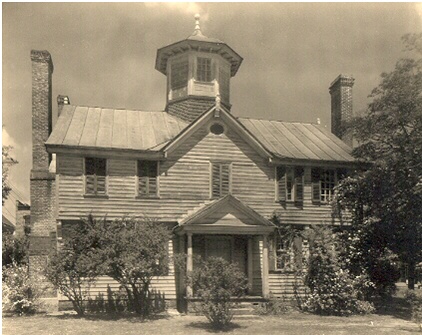
Captured in the shadows of the Cupola House, a Jacobean inspired Georgian house, the projecting portico of the Cupola House, provides the viewer with an experience which is beyond duplication. It can be reproduced, as a photographic image, but her ability to merge architectural history and preservation is second to none. The Cupola House has its own history, which began with its builder, a land agent for the last English Lord Proprietors, and continues today, as an adaptive reuse owned by the Cupola House Association, which is noted to be the earliest community effort to save a historic site in North Carolina. The Cupola House was designated a National Historic Landmark in 1971, and recently, as if December 2008, the Cupola House was awarded with a $115, 000 Save America’s Treasures grant by the President’s Committee on the Arts and Humanities and the National Park Service, which expresses the continued presence of Johnston’s immense documentation project.

Cupola House (1758), Edenton, North Carolina: Photo By Johnston

Even though Johnston, a pioneer of preservation, was deeply interested in capturing buildings in a state of decline, historic preservation and architectural history commonly focus on intact buildings and structures, and therefore ruins pose a unique study. They allow the viewer to interact with the past in a full sensory experience. Not only do ruins allow for introspective study, but they enact the process of preservation without the common imposition of restoring buildings, landscapes, and structures to their “appropriate” time period. The only complication to enriching viewers with the
 experience happens to be, composing equally dramatic photographs that captivate an audience.

It shall be stated, architectural history and historic preservation are tied together by the desire to push information through time, but they are equally hindered by temporal restrictions of time, space, and reality. While the photographic frame allows for easy replication of a perspective, it restricts the ability of time, space, and reality to fully evolve. Although, some photographic studies have attempted, by montage, to overlap time, and thusly created a type of photography that enacts preservation’s need to address the built environment as a useable human experience rather than just a sample of architectural vision fixed in time.

As stated by the National Park Service, “Architectural History is the study of the development of building practices through written records and design and the examination of structures, sites, and objects in order to determine their relationship to preceding, contemporary, and subsequent architecture and events”. While the standard definition for historic preservation is “the application of strategies that promote the identification, evaluation, documentation, registration, protection, treatment, continued use, and interpretation of prehistoric and historic resources” . There are also other disciplines that correlate with both architecture history and historic preservation. These professions are historic architecture, archeologist, historic landscape architect, historian, historic preservation planner, cultural anthropologist, engineering, folklorist, conservator, and curator. Not to mention, these professions are not the only related disciplines, but rather just direct examples that can easily be tied to architectural history and historic preservation.

It seems like an obvious point to make: architecture history and preservation’s tie-that-binds. At the same time, it is easy to overlook the importance of individual disciplines and techniques of documentation like photography, when we, students of the American educational system, are accustomed to absorbing curriculum without questioning its place. For example, as we trudge along through our undergraduate degrees, we check off requirements, and blink our eyes in delight as we speed along to some professional destination. Yet, it is the simplicity of what we study that explains why we study, and the complexity enters when we yearn to learn the how variations of our disciplines connect.

When we start to emphasize what historic preservation does for architecture history, as well as, the inverse, that the true brilliance of each discipline emerges. All too often, urban specialization blankets our desire to understand why we do what we do, and we demean our own desire for specialization through the ignorant flailing of commercial need (we lose sight out importance when focusing on economic demand for our academic specialization). Architecture History gives Preservationist the market to understand what is important for building techniques, it emphasizes the craft, and master architects/builders shine within the built effigies that preservationist preserve.

Cupola House, Present Day
As a Preservationist, I desire to protect buildings, landscapes, and structures that mean something to the architectural community. Not only am I looking at what was important, but I am also forecasting what will be important to future architects, architect enthusiasts, and society. I am not a preservationist who dances alongside the flame of whimsy. Simply because something is old, does not make it significant, and sometimes the old things we hold as significant are important for reasons other than we acknowledge. Frost and the “preservation mafia” of Charleston, South Carolina are, to me, examples of the wreck-less preservationists. These people seek to uphold a heritage of value and honor that did not exist… a sense of unfaltering Americana. They have the power, monetary influence, to impose their aesthetic taste and history onto the American people. When the ladies of Mount Vernon, or the Charleston crew, tried their hand at preservation, they created an empty vessel of bias and consumable America. They did not even begin to have the social mindedness needed to even mildly address the preservation issues created by their actions. In Charleston, black residents of the City were thrown out of their homes, because preservation efforts instigated the sale of the properties to, primarily, white northern investors. The return of the “traditional elite” meant that preservation, by nature, is discriminatory and faulted.

Contemporary preservation should preserve the full spectrum of history within the preserved buildings, structures, and objects. Not only are preservationist responsible for their subjective influence, but they should also be greatly responsible in representing objective realities in their work. Iconic imagery does greatly affect how we view our world, and if underrepresented, the impact of a single photograph can alter history. When captions are attached to photos, they add text to the context held within the “silent” frame, and can mislead future researchers.

Prehistory adds an element of abstraction from human history. Looking at the photographic images of Stonehenge, we find prehistoric architectural techniques that unfold unto other techniques, and become involved in a spectacle of time, space, and reality. Without the ruins, we cannot see where the stream of consciousness began, and we ultimately lose engineering, artistry, and cultural resources that speak to the symbolic and functional nature of humanity. Being able to preserve something before it turns to ruin is indefinitely the feat of a preservationist, but we shouldn’t view a ruin as being in need of restoration to some former glory. We seek to engage the community with the built environment, so that, architecture does not deteriorate to a state of ruin. While we can learn a lot from ruins, it is more useful for a community, society, to gain direct use from historic properties. If say Stonehenge retained its original use the mystery of Stonehenge would not exist, while sometimes mystery is interesting, most likely the knowledge lost in the mystery could serve as more beneficial than the source of mystery? Or does this mystery say something greater?

Stonehenge: A Ruin Standing With Impact: Present Day
Herein is the question, the answer, but Lise Hull depicts ruins in such a way that makes a cynical yet socially minded preservationist, such as me, stammer. “Ruins offer a different—sensory driven—pathway into the past. This is one of their most vital contributions. They visibly, physically, and emotionally breach the chasm between the present and the Middle Ages.” In her writing, she suggests that Windsor Castle, home to British monarchy, lacks the same association with the past, as per say, a castle ruin. While the pristine preservation of Windsor does show the strength of the nobility, it doesn’t create the same space as ruins. Ruins allow the viewer to imagine the space as it was hundreds, even thousands, of years prior to their occupation of the space. Time becomes a fleeting passenger for the viewer’s desire to overcome the bounds of space and time. Windsor, its collections of stately things, directly influence what the viewer experiences, and thus hampers the sensory experience regarding time and relativity. Historic preservationists are concerned with finding historic significance to place buildings, landscapes, and structures into appropriate eras of importance.

Windsor castle: Home to Monoarchy Not Man
While both preservation and architectural history are responsible for the keeping of collective memory, their responsibility should not stop at self imposed semantics. Standards and guidelines are necessary, but should not inhibit grow of free thought. While specializations are needed to continue advancement of study, as in the case of Windsor versus a ruin, each should be judged by its own merit, because each influences society is a different manner. Preservation tends to inspect buildings under a critical eye, esthetically biased opinions, which shape our collective memory, and provide future generations with a glimpse of “history”. Architectural Historians provide the details, jargon, to perpetuate study, and research the precedents of technique and artistry. So, ruins provide a neutral ground for both disciplines. On one hand, Preservationists quiver, because ruins provoke perception of time differently than most historic buildings.

While on the other hand, Architectural Historians grimace, because ruins depict the dismantling of civilization. What should be taken from ruins is the grace of natural decline, and the ability to inform, even if, only a pile of stone and mortar. We often want to preserve things exactly as they were at their “highest” point of glory, does reality really allow for such sustainment of glory, or is this just an attainment of fantasy? Ruins would suggest that we need to seek out variations of pristine examples that not always include intact high vernacular. Perhaps the high vernacular is best represented as social stratification, rather than pristine elements of “society”. Society is, in turn, greater than elite examples of its architecture.

In the end, the examination of the inflected image determines our need for continued research and magnification of architectural images. If only to expose ourselves to subtext in photographic images, we can use ruins as a key to addressing the influence of time onto preserved buildings, structures, and objects. The continued question of appropriate period of significance will, most likely, continue with the discipline of historic preservation, but, as with Johnston and Woods, we can begin to see that our perception of time, space, and reality deserves representation. In order to gain a holistic understanding of space, architectural or not, the viewer should always search deeper before accepting a defined history.

Bibliography

Cupola House Association. Cupola House History. 2009. http://cupolahouse.org/history.html (accessed November 6, 2009).

Edenton, North Carolina. Heritage Tourism Division. December 10, 2008.
http://www.visitedenton.com/News/News.detail.asp?ID=17 (accessed November 5, 2009).

Hull, Lise. Understanding the Castle Ruins of England and Wales. Jefferson, North Carolina, and London: MacFarland and Company, Inc., 2009.

National Park Service. Historic Preservation Professional Qualification Standards. unknown. http://www.nps.gov/history/local-law/gis/html/quals.html (accessed November 1, 2009).

Woods, Mary. Beyond the Architect's Eye: Photographs and the American Built Environment. Philidelphia: University of Pennsylvania Press, 2009.